Anti-aliasing is a critical technique in rendering graphics that aims to reduce the visual artifacts known as “aliasing.” These artifacts manifest as jagged edges or distortions, particularly in high-contrast areas where sharp transitions between colors occur. As graphics technology advances, the importance of anti-aliasing becomes more pronounced, especially in applications requiring high-quality visuals, such as video games, animations, and simulations. This article delves into the concept of anti-aliasing, its various methods, and its significance in rendering.
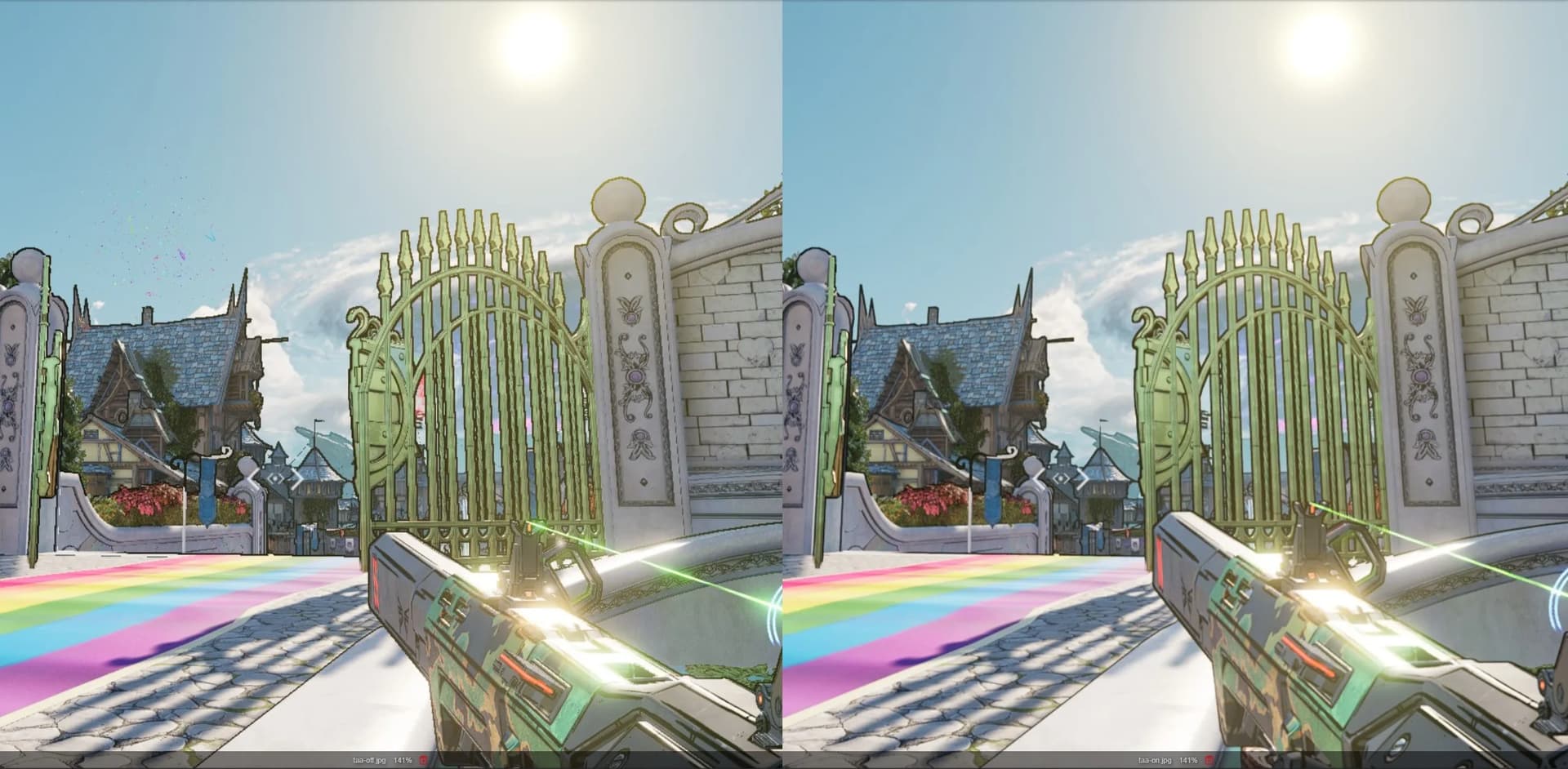
Understanding Aliasing
What is Aliasing?
Aliasing occurs when high-frequency detail in an image is inadequately represented in a lower-resolution format, leading to visual distortions. This phenomenon can result in jagged edges, moiré patterns, or other unwanted artifacts. Aliasing is particularly noticeable in computer graphics when rendering lines, edges, and curves.
Causes of Aliasing
- Sampling Rate: Aliasing primarily arises from insufficient sampling of an image. When the sampling rate of a digital image is lower than the Nyquist rate, it can lead to distortions.
- High-Frequency Content: Images with high-frequency details, such as sharp edges or fine textures, are more susceptible to aliasing. When these details are sampled, they may not be accurately represented.
- Rendering Resolution: Lower rendering resolutions exacerbate aliasing effects. As pixels are fewer, they may not capture the nuances of high-frequency details.
Visual Examples of Aliasing
- Jagged Edges: Straight lines appear stair-stepped rather than smooth.
- Moiré Patterns: Patterns emerge when fine details overlap at certain angles, creating visual disturbances.
- Texture Distortion: Textures may appear to shimmer or warp as the viewing angle changes.
The Concept of Anti-Aliasing
Definition
Anti-aliasing is a technique used in computer graphics to minimize the visual impact of aliasing by smoothing out jagged edges and improving the overall quality of rendered images. It works by blending colors at the boundaries of pixels to create the illusion of smoother transitions.
Importance of Anti-Aliasing
- Visual Quality: Anti-aliasing significantly enhances the visual quality of images, making them more appealing and realistic.
- User Experience: In gaming and interactive applications, reducing aliasing improves the overall user experience by providing clearer and more immersive visuals.
- Professional Standards: High-quality rendering is essential in fields like film, animation, and design, where visual fidelity is paramount.
- Competitive Edge: In the gaming industry, superior graphics can be a key differentiator, attracting players and enhancing engagement.
Types of Anti-Aliasing Techniques
Several anti-aliasing techniques exist, each with its advantages and disadvantages. The choice of technique may depend on the specific application, performance constraints, and desired visual quality.
1. Spatial Anti-Aliasing
Spatial anti-aliasing techniques involve manipulating the color values of pixels based on their spatial arrangement to create smoother edges.
a. Supersampling Anti-Aliasing (SSAA)
Supersampling Anti-Aliasing is one of the most straightforward methods. It involves rendering the image at a higher resolution than the target display and then downsampling to the desired resolution.
- How It Works: The scene is rendered at a higher resolution (e.g., 4K) and then scaled down to the target resolution (e.g., 1080p). This process averages the colors of the higher-resolution pixels to produce smoother edges.
- Advantages:
- Provides high-quality results with minimal artifacts.
- Works well with all types of geometry.
- Disadvantages:
- Computationally expensive due to the need for higher rendering resolution.
- Can be slow and resource-intensive.
b. Multisampling Anti-Aliasing (MSAA)
Multisampling Anti-Aliasing is a more efficient alternative to SSAA that focuses on sampling multiple points within each pixel.
- How It Works: Rather than rendering the entire scene at a higher resolution, MSAA samples multiple locations within each pixel and averages the results to create smoother edges.
- Advantages:
- More efficient than SSAA, as it does not require a full-resolution render.
- Provides significant improvement in visual quality without excessive computational cost.
- Disadvantages:
- Less effective for transparency and complex textures compared to SSAA.
- Can still be demanding on the GPU.
c. Coverage Sampling Anti-Aliasing (CSAA)
Coverage Sampling Anti-Aliasing is an extension of MSAA developed by NVIDIA, which improves upon the efficiency of multisampling.
- How It Works: CSAA samples fewer coverage samples than MSAA but enhances the quality of edge smoothing by utilizing additional depth and color information.
- Advantages:
- Reduces memory usage and improves performance while maintaining quality.
- Effective for scenes with complex geometry.
- Disadvantages:
- Still requires some hardware support and may not be universally available on all systems.
2. Temporal Anti-Aliasing
Temporal anti-aliasing techniques utilize information from previous frames to smooth out edges over time.
a. Temporal Anti-Aliasing (TAA)
Temporal Anti-Aliasing combines information from multiple frames to reduce aliasing artifacts.
- How It Works: TAA uses the previous frame’s color data and motion vectors to blend it with the current frame, creating smoother edges and reducing flickering.
- Advantages:
- Effective at reducing flickering and shimmering in moving objects.
- Provides high-quality results with lower performance costs than spatial methods.
- Disadvantages:
- Can introduce ghosting artifacts, especially in fast-moving scenes.
- Requires motion vectors, which may not be available in all applications.
3. Post-Processing Anti-Aliasing
Post-processing techniques apply anti-aliasing after the image has been rendered.
a. Fast Approximate Anti-Aliasing (FXAA)
Fast Approximate Anti-Aliasing is a popular post-processing technique that smooths out edges without requiring higher-resolution rendering.
- How It Works: FXAA analyzes the final image and detects edges, applying a blur effect to smooth them out.
- Advantages:
- Very fast and computationally efficient.
- Works well with existing rendering pipelines without requiring changes to geometry.
- Disadvantages:
- Can produce a loss of detail, particularly in textures.
- Less effective than spatial methods in high-contrast edges.
b. SMAA (Subpixel Morphological Anti-Aliasing)
SMAA combines the strengths of different anti-aliasing techniques to achieve high-quality results with better performance.
- How It Works: SMAA uses a combination of edge detection, blending, and subpixel calculations to smooth edges effectively.
- Advantages:
- Provides high-quality results comparable to MSAA with lower computational costs.
- Can be implemented as a post-processing effect.
- Disadvantages:
- May still struggle with certain types of textures or complex geometries.
- Requires careful tuning for optimal results.
Importance of Anti-Aliasing in Rendering
1. Enhancing Visual Quality
The primary goal of anti-aliasing is to enhance the visual quality of rendered images. By smoothing out jagged edges and reducing artifacts, anti-aliasing contributes to a more polished and professional appearance. This is especially crucial in high-fidelity applications like video games, films, and architectural visualizations, where visual realism is paramount.
2. Improving User Experience
In interactive applications, such as video games and simulations, reducing aliasing directly impacts user experience. Smooth visuals lead to increased immersion and satisfaction. Players are less likely to be distracted by visual artifacts, allowing them to engage more fully with the content.
3. Maintaining Professional Standards
In fields like film production and graphic design, maintaining high visual standards is essential. Anti-aliasing helps meet industry expectations for quality, ensuring that visual content appears professional and polished. This can be a deciding factor in attracting clients or audiences.
4. Supporting Modern Graphics Techniques
With the rise of advanced rendering techniques such as ray tracing and complex shaders, the need for effective anti-aliasing becomes more critical. As graphics technology evolves, so do the challenges associated with aliasing. Effective anti-aliasing methods are necessary to ensure that new techniques deliver their full potential without introducing distracting artifacts.
5. Competitive Advantage
In the gaming industry, visual quality can be a significant differentiator. Titles that employ effective anti-aliasing techniques can stand out in a crowded market, attracting players seeking high-quality graphics. This competitive edge can lead to increased sales and player retention.
Challenges in Implementing Anti-Aliasing
1. Performance Constraints
One of the primary challenges in implementing anti-aliasing is balancing visual quality with performance. Techniques like SSAA can deliver exceptional results but often at the cost of significant computational resources. Developers must carefully consider the target platform’s capabilities to avoid performance degradation.
2. Compatibility Issues
Not all anti-aliasing techniques are compatible with all rendering engines or graphics hardware. Some methods may require specific support from the GPU or rendering pipeline. Ensuring that the chosen anti-aliasing technique works seamlessly within the existing framework can be a challenge.
3. Artifacts and Limitations
While anti-aliasing significantly reduces aliasing artifacts, it is not a perfect solution. Techniques may introduce their own artifacts, such as ghosting in TAA or blurring in FXAA. Developers must be aware of these limitations and choose methods that best suit their specific needs.
4. Resource Management
Implementing anti-aliasing techniques requires careful resource management. Developers must ensure that the rendering pipeline can handle the additional processing load without negatively impacting overall performance. This may involve optimizing other aspects of the rendering process to compensate for the added complexity.
Conclusion
Anti-aliasing is a fundamental technique in rendering that enhances visual quality, improves user experience, and supports modern graphics technologies. By reducing aliasing artifacts, anti-aliasing contributes to the overall realism and professionalism of rendered images. Various techniques, from supersampling to post-processing methods, offer developers options to balance visual fidelity with performance constraints.
As graphics technology continues to evolve, the importance of effective anti-aliasing will only grow. By understanding the principles of anti-aliasing and its significance in rendering, developers can create more visually appealing and immersive experiences for users. The ongoing challenge lies in selecting the right techniques to meet the demands of modern applications while maintaining optimal performance. Ultimately, anti-aliasing remains a vital aspect of the rendering process, crucial for achieving high-quality visuals in a competitive landscape.