Computer graphics have evolved significantly, particularly with the advent of advanced rendering techniques. Among these, ray tracing and rasterization stand out as two fundamental approaches to rendering images. Each technique has its strengths and weaknesses, impacting visual quality and performance. This exploration delves into the differences between ray tracing and rasterization, examining their methodologies, visual outputs, performance metrics, and applications.
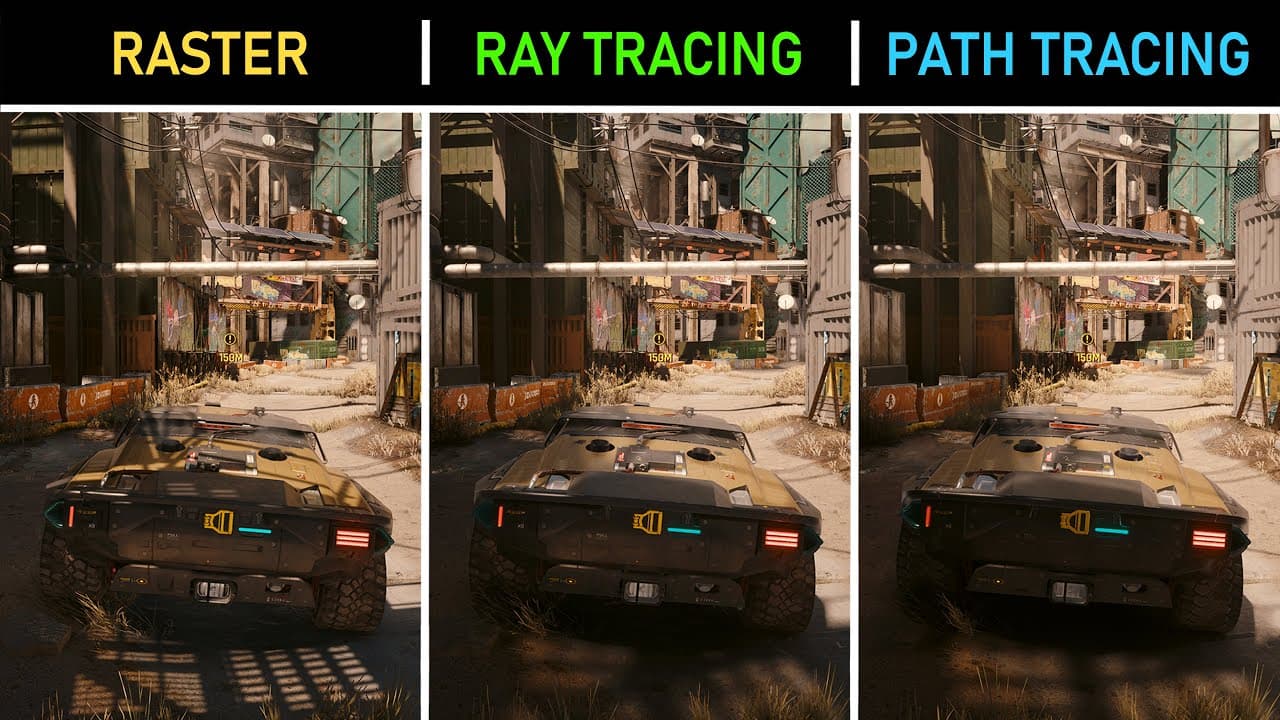
1. Understanding the Basics
1.1 Rasterization
Rasterization is a process that converts vector graphics, represented as geometric shapes, into a raster image (pixels or dots) for output on a display. It primarily focuses on rendering 2D images from 3D models by projecting them onto a 2D plane.
Key Steps in Rasterization:
- Vertex Processing: Transforming 3D coordinates into 2D screen coordinates.
- Primitive Assembly: Creating geometric primitives (triangles, lines) from vertices.
- Rasterization: Converting these primitives into fragments, which correspond to pixels on the screen.
- Fragment Processing: Applying shaders to determine the color and depth of each fragment.
- Output Merging: Combining fragments to produce the final pixel values on the screen.
1.2 Ray Tracing
Ray tracing simulates the way light interacts with objects to create images. It traces the path of rays of light as they travel through a scene, calculating color and brightness based on light interactions.
Key Steps in Ray Tracing:
- Ray Generation: Rays are cast from the camera into the scene.
- Intersection Testing: Determining which objects (if any) the rays intersect.
- Shading: Calculating the color of the intersected object based on lighting, material properties, and textures.
- Reflection and Refraction: For reflective and transparent materials, new rays are generated to simulate light bouncing off surfaces or passing through them.
- Final Image Composition: Combining the results of all rays to produce the final image.
2. Visual Quality Comparison
2.1 Lighting and Shadows
Ray Tracing:
- Global Illumination: Ray tracing naturally simulates global illumination, capturing how light bounces off surfaces and illuminates other areas of the scene.
- Soft Shadows: It can produce soft shadows with penumbra effects, where the shadow’s edges are blurred based on distance from the light source.
Rasterization:
- Local Illumination: Typically relies on local illumination models, calculating lighting effects based on direct light sources without accounting for indirect light.
- Hard Shadows: Shadows are usually hard-edged unless additional techniques (like shadow mapping) are employed.
2.2 Reflections and Refractions
Ray Tracing:
- Accurate Reflections: Ray tracing can produce accurate reflections, including reflections of reflections (recursive reflections), capturing complex interactions between surfaces.
- Realistic Refractions: It handles refraction through transparent materials accurately, bending light according to Snell’s law.
Rasterization:
- Screen-Space Reflections: Rasterization often uses screen-space reflections, which can be less accurate as they only reflect what is currently visible in the scene.
- Refraction Techniques: Techniques like refraction mapping or approximations are used, which may not be as realistic as ray tracing.
2.3 Texture Quality and Detail
Ray Tracing:
- High-Quality Textures: Ray tracing can produce high-quality textures with detailed lighting effects, such as specular highlights and subsurface scattering.
- Detailed Material Properties: Complex material properties can be accurately represented, resulting in more realistic surfaces.
Rasterization:
- Texture Mapping: Uses texture mapping techniques, which can sometimes lead to artifacts if not managed well (e.g., mipmapping issues).
- Less Detail in Complex Materials: While shaders can enhance texture quality, complex interactions may require additional techniques to achieve realism.
2.4 Anti-Aliasing
Ray Tracing:
- Natural Anti-Aliasing: Ray tracing inherently reduces aliasing artifacts due to the way it samples light, producing smoother edges.
Rasterization:
- Post-Processing Techniques: Rasterization often requires post-processing techniques like MSAA (Multisample Anti-Aliasing) to reduce jagged edges, which can be computationally expensive and may not be as effective as ray tracing’s natural approach.
3. Performance Comparison
3.1 Computational Complexity
Ray Tracing:
- High Computational Load: Ray tracing is computationally intensive due to the need for complex calculations for each ray, especially in scenes with multiple light sources, reflections, and refractions.
- Scalability Issues: Performance can degrade significantly in complex scenes, making real-time applications challenging without powerful hardware.
Rasterization:
- Faster Performance: Rasterization is generally faster, as it processes geometric data directly and uses hardware acceleration effectively (e.g., through GPUs).
- Real-Time Rendering: Well-suited for real-time applications, such as video games, where frame rates are critical.
3.2 Hardware Utilization
Ray Tracing:
- Dedicated Hardware: Modern GPUs increasingly include dedicated ray tracing cores (e.g., NVIDIA’s RTX series) to improve performance and efficiency in ray-traced rendering.
- Memory Bandwidth: High memory bandwidth is essential for handling the large data sets often involved in ray tracing.
Rasterization:
- Established Pipeline: Rasterization benefits from decades of optimization in graphics hardware, making it highly efficient for most real-time applications.
- Versatile GPU Use: Works well on standard GPUs without the need for specialized hardware.
3.3 Parallelism
Ray Tracing:
- Parallel Processing: While ray tracing can leverage parallel processing, the complexity of individual rays can lead to inefficiencies in certain scenarios. Techniques like bounding volume hierarchies (BVH) help optimize this.
Rasterization:
- Efficient Parallelism: Rasterization inherently supports efficient parallel processing, as each pixel can be computed independently, making it ideal for GPU architectures.
4. Hybrid Approaches
4.1 Combining Techniques
As the demand for high-quality graphics in real-time applications grows, hybrid approaches that combine ray tracing and rasterization are becoming more prevalent.
- Ray Traced Reflections and Shadows: Many modern games use rasterization for primary rendering but employ ray tracing for reflections and shadows to enhance visual quality without a complete shift to ray tracing.
- Dynamic Lighting: Hybrid techniques can dynamically adjust lighting and shadow quality based on performance, providing a balance between quality and speed.
4.2 Future Trends
The future of graphics rendering is likely to see further integration of ray tracing and rasterization techniques. As hardware continues to evolve, the performance gap may narrow, allowing for more complex ray tracing implementations in real-time applications.
5. Applications
5.1 Video Games
Rasterization has dominated video game graphics for decades due to its efficiency and speed. However, as hardware improves, ray tracing is making inroads for enhanced realism in lighting and reflections.
5.2 Film and Animation
Ray tracing is widely used in film and animation for its ability to produce stunningly realistic visuals. The time required for rendering frames in film is less critical than in gaming, allowing artists to take full advantage of ray tracing’s capabilities.
5.3 Architectural Visualization
Both techniques are employed in architectural visualization. Rasterization is used for quick previews, while ray tracing is reserved for final renders, where visual fidelity is paramount.
5.4 Virtual Reality
In virtual reality, performance is crucial. While rasterization provides the necessary frame rates for immersive experiences, ray tracing can enhance realism when hardware allows, particularly in high-end VR setups.
Conclusion
Ray tracing and rasterization serve distinct roles in the realm of computer graphics, each with its advantages and limitations. While rasterization excels in speed and real-time rendering capabilities, ray tracing offers unparalleled visual quality, particularly in simulating realistic lighting and material interactions.
As technology advances, the lines between these techniques are blurring, leading to innovative hybrid approaches that harness the strengths of both. Understanding the differences between ray tracing and rasterization is essential for developers and artists alike, guiding them in choosing the right techniques for their specific applications.
In summary, both rendering techniques have their place in the graphics landscape, and the choice between them should be informed by the specific requirements of the project at hand—balancing visual quality and performance in the pursuit of stunning visual experiences.